How We Approach Employee Compensation at Help Scout




What someone gets paid can feel like an assessment of what they’re worth, so like it or not, what you pay people is personal. While this can be a very loaded topic, we try to keep things clear and equitable at Help Scout so our entire team feels valued.
Think about it like this: If you inadvertently shared a spreadsheet of everyone’s salary with the whole company, could you stand by it with a sound explanation as to why people get paid what they do compared to each other and to market data?
If the answer is no, you have work to do. At Help Scout, we strive to answer that question with a confident yes.
5 ways to nail your employee compensation strategy
Compensation is complicated, and it can get messy when you don’t have a good plan in place. It impacts every person on your team — not to mention those future hires you have your eye on.
Here are several approaches we’ve taken and lessons we’ve learned along the way that will give you a good start when you dive into creating (or improving) your employee compensation strategy.
1. Dig for that data
First things first: Round up some data! Plenty of resources out there (such as Radford, Payscale, and Glassdoor) offer compensation data, and some of them, like Culpepper, offer a price break for new and emerging companies.
It’s a lot of work (and not always possible) to match roles to the surveys, but it’s worth it to see what percentile you’re paying compared to other companies of a similar size, region, funding stage, or revenue amount.
We use Pave and Mercer as our main data sources when conducting research, and pay is tied to our employees’ geographic locations. For U.S. employees, we benchmark our salaries against technology companies in the Boston metropolitan area, and for teammates outside of the U.S., we focus on major metropolitan cities in their corresponding countries. We review the data formally at least once a year and monitor throughout the year to make sure our salaries stay aligned with the benchmarks.
There are plenty of pros and cons to tying pay to location. We chose this approach for a few reasons, one of which is equity; location-based pay ensures that all employees have comparable spending power. We also moved to paying in local currency as it reduces the volatility that comes with fluctuating exchange rates.
Regardless of location, we aim to pay our team at the 75th percentile of their role’s salary range. That means we’re targeting the higher end — roughly what the top 25% of employers in that market pay.
For international contractors, we start with the same local benchmarks we use for employee roles, then we add an adjustment to account for the additional costs and responsibilities that contractors typically manage on their own. These are things like health care, paid time off, and retirement planning.
In general, we aim to be generous and competitive, not just average. This helps us attract and retain great people while staying sustainable and equitable across regions.
2. Form a framework
We love constraints at Help Scout, and our salary matrices are one of our self-imposed constraints. It helps hold us accountable to our team with a structure that’s fair and transparent. It also prevents us from picking numbers out of thin air when making offers to candidates.
A handful of companies take the transparency a level further and share what each specific team member makes; we don’t do that, but our salary matrix numbers are available internally for team members to see.
We have two types of salary matrices at Help Scout: one for folks on the individual contributor (IC) track and another for those on the management track. Each matrix is made up of levels — 1 to 5 for ICs and 6 to 8 for managers — and within each level are five salary bands, labeled A through E.
Bands A–E represent a spectrum within a level, reflecting an employee’s experience, performance, and growth. This structure helps us reward growth and impact over time, even if someone isn’t changing roles or titles.

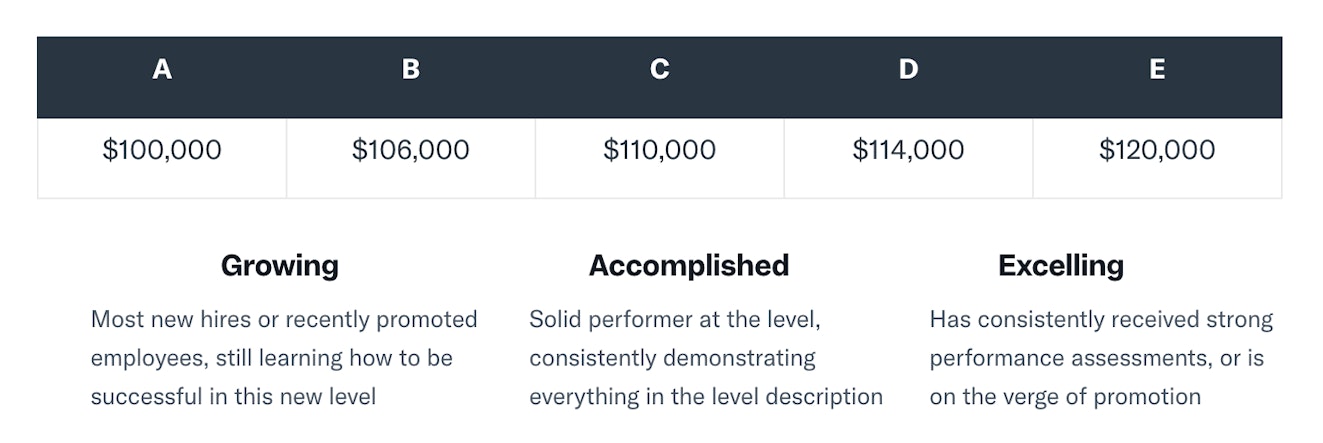
Every team across the company (engineering, marketing, customer support, etc.) has its own set of matrices.
Defining levels and bands
Each of the levels are broadly defined across the company, including competencies we’d like to see at each level. For example, we think of a Level 2 (L2) as someone early in their career but with a few years of solid experience. Level 3 includes more senior individual contributors and so on.
Each team then takes the broadly defined levels and competencies and develops role-specific growth frameworks. Our goal is to have everyone understand what it takes to move forward in their career and to know what's required to get there.
Here’s an example of how competencies are defined at the company level vs. the role level.
| Competency | Company level L2 | Brand developer L2 |
|---|---|---|
Expertise You have the general experience and knowledge necessary for the level. |
|
|
Leveling up
We conduct performance reviews twice a year. Career progression is measured by milestones that individual contributors and managers map out together, and it’s discussed during review periods.
There is not an expectation that people will level up every single year; moving up can happen whenever the person has consistently demonstrated the behaviors required for the next band.
3. Align your compensation strategy with your company values
Although all of our matrices are tied back to role-specific market rate salaries, compensation is an art, not a science. As a company, you have the power to decide when you want to be influenced by the market and when you want to disrupt it.
For example, some tech companies will decide to pay above market for some roles (typically engineers and product managers) but at market for what they consider roles that are easier to fill (like customer service).
At Help Scout, we pay above-market rates for our customer support roles, because we believe this function is wildly undervalued and underutilized in most businesses. We also believe that support is a key factor in our success and want to compensate our support team in kind.
With a more purposeful and opinionated compensation approach, you’ll find the values-aligned, talented people you need more easily — and they’ll be paid properly.


4. Be purposeful with perks
A lot of perks used to be designed to pull people into an office or keep them working longer hours — like free food, games, gyms on site, and so on. However, now that many companies are remote-first or hybrid, offering meaningful benefits that aren’t just office-based is critical.
Patty McCord says in Powerful: Building a Culture of Freedom and Responsibility:
People’s happiness in their work is not about gourmet salads or sleeping pods or foosball tables. True and abiding happiness in work comes from being deeply engaged in solving a problem with talented people you know are also deeply engaged in solving it, and from knowing that the customer loves the product or service you all have worked so hard to make.
Help Scout is not a family. It’s a group of values-aligned people who want to do great work together, then log off and return to their families, friends, side-hustles, and hobbies.
We want people to feel empowered to do their best work while being fully supported, so our benefits include things like a “learn something” stipend, home-office and co-working stipends, a paid sabbatical every four years, and equal paid parental leave for all new parents, including adoption and foster care.
We’ve also chosen to be as generous as possible when it comes to covering our employees’ basic needs. We cover 100% of the monthly premiums for the employee portion of medical, vision, and dental insurance, pay for long-term and short-term disability insurance, and offer a basic life insurance policy that is equal to 1x the employee’s salary. We also have a 401K match and a Flexible Spending Plan.
We regularly revisit our benefit offerings and try to improve upon them whenever we can, but even if we had a physical office, you’d never see a foosball table on that list.
Adding bonuses to your compensation strategy
In addition to perks, bonuses are another tool that you may consider adding to your compensation strategy. At Help Scout we offer spot bonuses, which are a way for us to recognize work that has had a substantial impact on the business.
We wanted to keep the strategy simple, so we set up three tiers — based on the significance of the contribution — and assigned corresponding monetary awards. When managers see a member of their team going above and beyond, they can nominate the employee for a spot bonus.
Your company may take an alternative approach, such as company-wide performance-based bonuses, bonuses based on team goals, or something else entirely.
The money you spend on benefits, perks, and bonuses is a piece of the compensation puzzle, and what you decide to spend it on reflects your values as a company. Choose wisely, and you’ll attract candidates who value what you value.
5. Expect change
The market is always changing, and being intentional about compensation is one of the best ways to attract amazing talent. You don’t want to miss out on great teammates because you haven’t been thoughtful about your approach, and believe us, candidates will be asking about it.
You also need to be willing to adapt. For example, when we were just getting started, we grouped common job families together. As the company grew and roles became more specialized, we created new job families, like breaking out Product Operations instead of keeping it under Product. We also revisited our Account Executive sales formulas as our pricing evolved, ensuring the two stayed aligned.
When it comes to compensation, keep an open mind and expect it to evolve. If you lead with your values, leverage the data, and share openly with your team, you’ll be more likely to land on a strategy that feels fair and inspiring.
Build a system that’s right for you
Compensation will probably never be a light topic. It affects how secure people feel, how valued they feel, and sometimes whether they stay at your company, which is why it’s worth slowing down and getting it right.
We’ve put a lot of thought into our approach, but you don’t need our exact playbook. What matters is building a system that reflects your values and holds up as your company grows.
Leah Knobler
Leah is the VP of People at Help Scout, a fully-remote company of 145 people building helpful, human customer support tools. When not at work, she loves spending time with her wife, toddler, and pit mix, Nova, in their home in Philadelphia. Connect with her on LinkedIn.